-
Craven Arms Public House Thatched Roof Protection
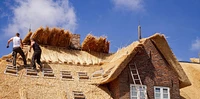
As the first of its kind to be built since the times of Henry the VIII, these cruck framed buildings were once a common sight in the Yorkshire Dales, but now only a few still stand. Using detail from the remaining few, Cruck Barn – part of the Grade II listed Craven Estate - was constructed in 2006, using traditional methods and materials to create a beautiful, thatched-roof building.
Thatch roofs are built using dry vegetation such as straw, water reed, sedge, rushes or heather and are typically seen on old traditional cottages or heritage buildings - with the property boasting a large Inglenook fireplace, along with regularly burning candles, the proprietors needed an effective means of early fire detection to ensure continued safety of the area and surrounding shepherd’s huts.
- Client:
- The Craven Arms, Craven Estate
- Sector:
- Infrastructure
- Application:
- Thatched Roof Protection
- Location:
- The Yorkshire Dales, Appletreewick
- Date:
- 2006
The Problem/Scope of Work
Aiming to refurbish the 16th century farm house - which once belonged to William Craven, Lord Mayor of London – the property owner, Robert Aynsworth, was determined to make the building sympathetic to its heritage, while ensuring it was protected from fire.
However, commissioning a fully thatched roof came with several risks, including how well dry thatch burns. Other risks include:
- The strength of fire within the thatch
- The danger posed by the internal fireplace and chimneys – especially if not having regular checks
- Sparks from paper or burned rubbish can also ignite dry thatch on the surface around a chimney
- Thatch fires can cause extensive damage to a property, not just because of the damage to the roof, but also due to the large amounts of smoke that is produced
- While traditional detectors can be placed in roof voids, and in the main areas of the building, they are unable to detect the early stages of fire or provide continuous monitoring
- Thatch roofs can produce a large amount of dust and other contaminants that are left floating around roof voids, potentially rendering traditional type detectors ineffective.
The Solution
Linear heat detection (LHD) provides continuous monitoring of a thatched roof and, by installing heat sensing cable in the thatch and around the chimney, the whole roof area can be monitored for excess heat.
With the need to mitigate risks of false alarms or delayed activation due to dust or damp, The Craven Arms decided to use Thermocable’s ProReact Fixed activation LHD solution. Approved to both UL and EN54-28 specifications, this system uses heat sensing cable to detect increases in temperature, providing an accurate location of an overheat event, before the fire can spread.
Benefits
Shortlisted for the 2007 National Wood Awards, for the best use of British timber, the building was re-established as one of the best known structures in the Yorkshire Dales. By utilizing our ProReact LHD solution, benefits include:
- Unparalleled fire detection capabilities, ensuring early identification and prompt response to potential fire incidents
- Easy to install, fast and reliable detection
- Suitable for use in damp, dirty, dusty and hard to maintain environments, LHD prevents false alarms
- Effective and low maintenance, with a lifetime guarantee
- Less labour required to install when compared to spot heat detection
.png)
ProReact Fixed Activation (EN)
Preset alarm temps. Tough cable. Reliable fire safety.
- UL and EN approved
- CE, RoHS, and UKCA certified
- LSZH coating, UV stability, and hydrocarbon resistance
- Optional stainless steel braiding for mechanical protection
For any queries on this project, or to find out how linear heat detection can assist you with asset and life protection, you can get in touch with our Commercial Manager on [email protected]